

This chapter of the CQ Researcher discusses the growing wealth gap separating the richest and the poorest of Americans and the consequential dissolution of the middle class. Income inequality is said to be one of the “defining issues of our time,” and yet the wealth gap continues to grow and send the lower and middle classes on a wild goose chase for the ever increasingly unattainable fallacy that is the American Dream (which typically encompasses opportunities and achievements such as personal freedom, financial security, owning a home, and retirement). There are issues that truly touch my heart, but this is a case that only fills me with frustration and rage. So while this opinion may be the showing of the inner anarchist in me, a poll conducted by ORC International suggests that it may not be that unpopular:
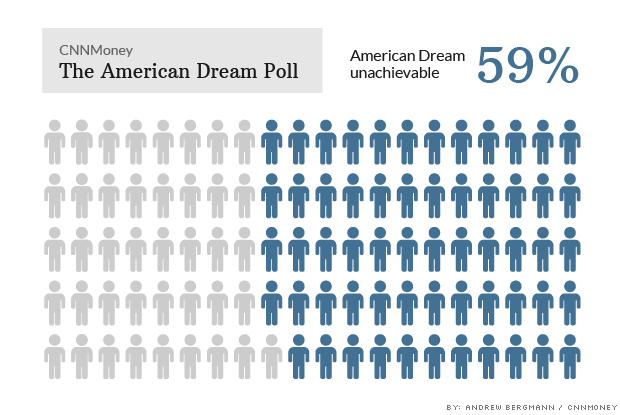
In fact, 59% of those sampled for the American Dream Poll (literally what it’s called) agreed that the American Dream is unachievable, and experts say that this significant value is not surprising.
Within the larger realm of income inequality, the chapter also delves into the issue of wage stagnation and the inability of wages to keep up with the cost of living, which has the effect of reducing consumerism (particularly on behalf of middle class) and disproportionally skewing, if not lowering, the GDP (Gross Domestic Product) value that represents the “health” of our nation’s economy and wealth. In this way, wage stagnation is strongly correlated with inequality and the educational gap between upper and lower class children, a social pressure designed to keep the lower class children poor and inhibit their social mobility. Inequalities within the American education system have been cited as the primary cause of this education gap, as the compromised quality of public schools within lower class areas discourages children residing in such areas from successfully graduating, receiving a diploma, and obtaining a full time job that keeps them out of the cycle of poverty. The result of such a biased system is what James Ryan, the Dean of the Harvard Graduate School of Education, refers to as the “ironclad link between a child’s ZIP code and [their] chances of success.” It is proof of the stalling of upward mobility, a concern also expressed by Americans sampled for the American Dream Poll:
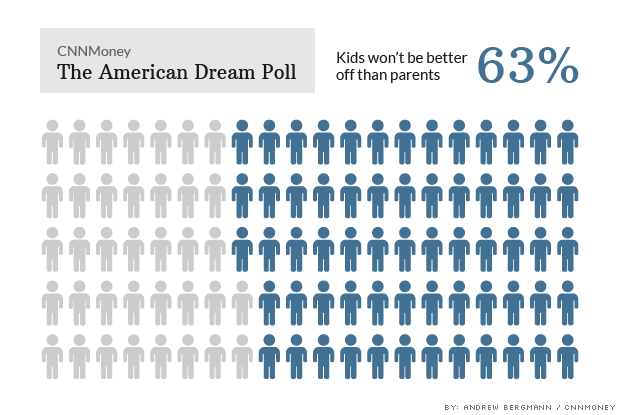
63% of individuals sampled by the poll agreed that children of immigrant parents likely won’t be better off than their parents, exhibiting an attitude of pessimism that Erin Currier, director of the Economic Mobility Project at Pew Charitable Trusts, claims is “reflective of the financial realities a lot of [American] families are facing. They are treading water, but their income is not translating into solid financial security” (Luhby).
The representation of this issue in my brain is that of a hardworking individual running until the point of exhaustion on a treadmill, running only because they were told that is what they have to do to attain a prize that has already been given to someone else, a prize they never really had a fair shot at earning despite their continual toil and effort. They usually don’t know that the prize has already been given away to someone else until after they have put in all the toil and effort, but by this point they feel too powerless and defeated to even challenge the injustice. Imagine navigating through this nightmare of a reality daily, only to recharge for several hours and do it all over again the next day. Some look forward to the weekend to get through the day, but resting over the weekend is a luxury some cannot even afford. Yes, we have come a long way from the days of living in tenements, but working class Americans are still miserable.
Most politicians seem to agree that raising the minimum wage and reducing tax cuts for the wealthiest of Americans are the best strategies for reversing what Bernie Sanders has called an “enormous transfer of wealth” to the rich from the lower and middle classes. As on most issues, however, politicians clash on the details and strategies associated with implementing these initiatives. Conservatives who oppose reform on this issue typically make a case for “trickle down economics,” claiming that even the lower and middle classes will benefit as long as the economy benefits overall (which, according to them, it can continue to do as long as the wealthy continue to operate with minimal regulation). Unfortunately, this idea is yet another empty promise given by politicians who reside in the pockets of the wealthy and wish to remain there for personal benefit, and evidence has shown that the money never makes it down to where it is needed most because the force controlling where it goes is not, unfortunately, gravity. It is just another fallacy designed to hide the aftermath of the hijacking of the American Dream.
References:
- CQ Researcher,. Urban Issues: Selections from CQ Researcher. SAGE Publications. Kindle Edition.
-
Luhby, Tami. “The American Dream Is Out of Reach.” CNNMoney, Cable News Network, 4 June 2014, 4:01 AM ET, money.cnn.com/2014/06/04/news/economy/american-dream/index.html.
The representation of this issue in my brain is that of a hardworking individual running until the point of exhaustion on a treadmill, running only because they were told that is what they have to do to attain a prize that has already been given to someone else…
Now, that is good writing. This is a powerful essay and beautifully written.